Spotlight Volume 1: Jonathan Katz’s Leveraging AI for a More Responsive Math Curriculum
The K-4 educator uses AI to help plan and revise curriculum while keeping teachers’ judgment at the center of the work.
For Jonathan Katz, a strong math curriculum has to build understanding across grade levels and respond to what teachers see in their classrooms. Katz, who has worked in education for about 15 years, supports kindergarten through fourth-grade teachers through curriculum development, coaching, and classroom visits. He has built a set of AI assistants to help with the time-intensive work of planning and developing instructional materials.
Katz starts with Understanding by Design, a planning approach that identifies what students should understand by the end of a unit before mapping out lessons. His “Unit Architect” helps him explore essential questions, lasting understandings, and the skills students should carry forward. He built the assistant using examples from his own years of planning, examples of approaches to avoid, and guidance drawn from publicly available mathematics resources.
Other assistants serve distinct functions. The “Planner” helps turn unit goals into pacing guides. The “Surveyor” draws on publicly available curricula to help identify useful materials and create lesson supports. The “Remodeler” reviews existing materials and suggests changes when teachers’ classroom experience shows that students need a different approach. Katz used Gemini and NotebookLM to help organize and develop the system, and he works with versions in ChatGPT and Claude that bring different perspectives to the planning process.
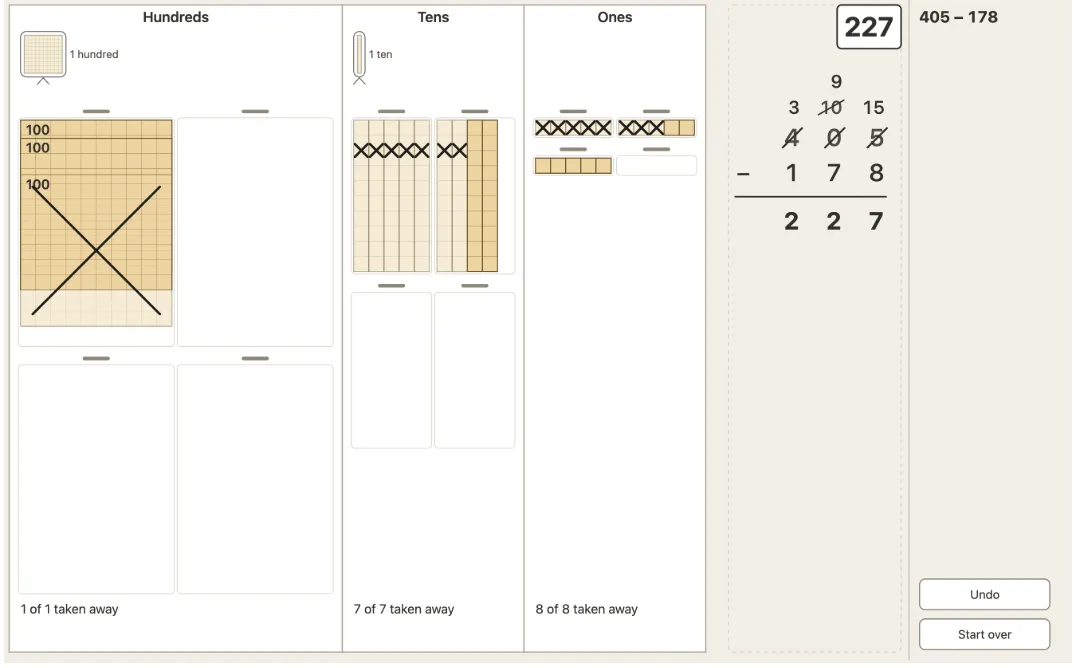
The tools also help him create materials students can use. With Claude, Katz made an interactive Place Value Algorithms Mat. When a student drags a hundred into the tens area, it separates into tens; tens can split into ones. During addition, ten ones can join to form a ten. This movement helps students see what happens when numbers are decomposed or regrouped. Katz sees the mat as a scaffold alongside physical base-ten blocks, which give children the experience of handling and moving objects themselves. He has also used ChatGPT to illustrate a math story that, he says, the children loved.
Katz estimates the tools may have saved him hundreds of hours, though he can’t give an exact figure. He values even more the ability to revise materials as teachers learn what works for their students. By his estimate, that work supports about 30 adults and indirectly reaches roughly 150 children.
Katz describes himself as an AI skeptic, even as he uses these tools. He treats their output as a starting point that he and teachers shape into instructional materials. He says he does not enter students’ or teachers’ names into the tools; when work samples are useful, they are anonymized.
“It can never replace the judgment of a skilled pedagogue,” he says. For Katz, "AI can help educators prepare and adapt, while teachers remain responsible for meeting students’ needs."

If interested in learning more, Katz is available by email at [email protected].