AICoP: From Access to Literacy to Fluency
The AI Community of Practice opened its fall season by turning the camera on itself. Instead of a faculty founder or an industry partner, the September session came from CUIT's AI & Emerging Technologies team, which spent the summer running the largest AI training effort Columbia has attempted — and came back with numbers, lessons, and a different plan for the fall.
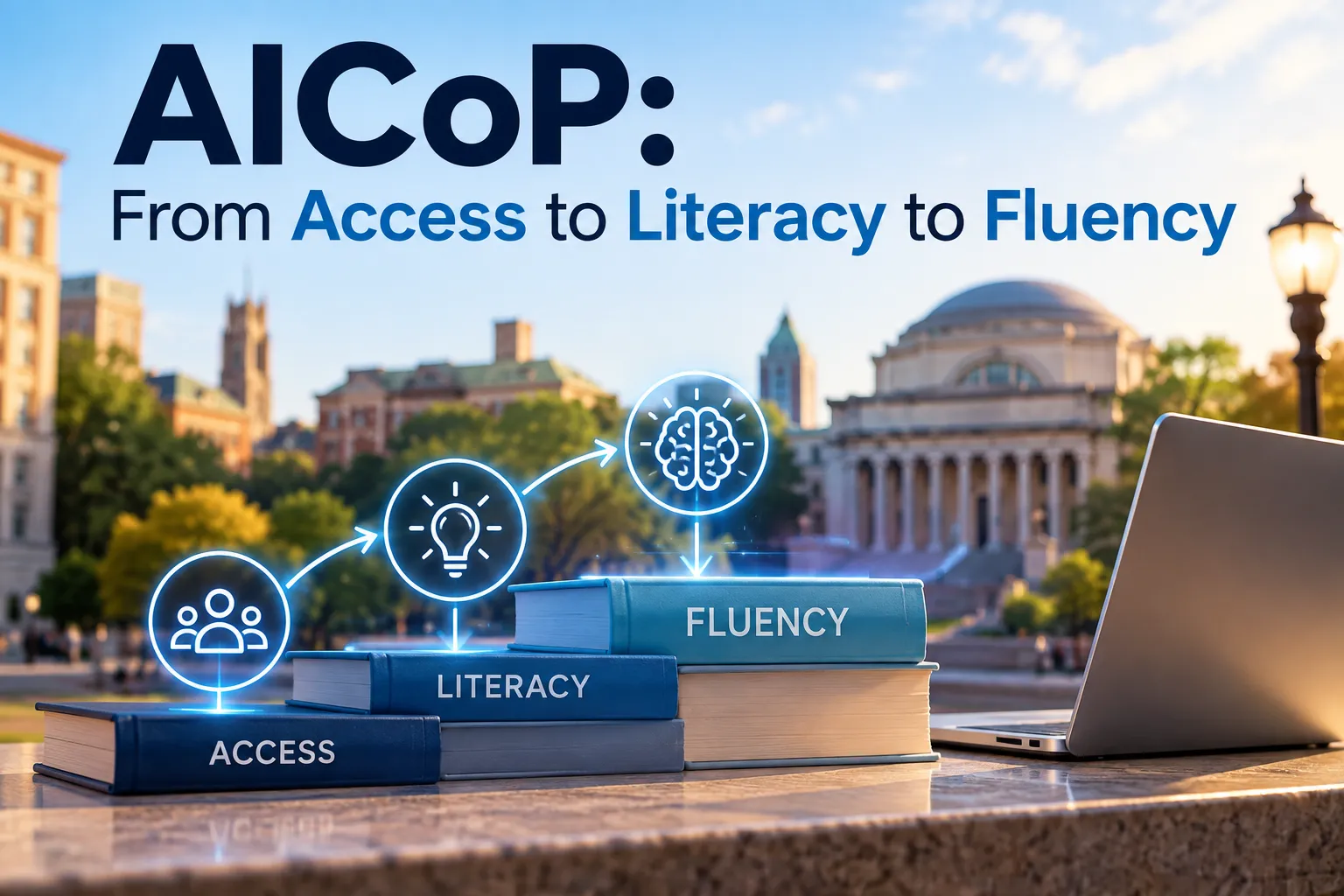
Parixit Dave, Senior Director for AI and Emerging Technologies, framed the arc plainly: access first, then literacy, then fluency, then transformation. Access is largely done. The rest is the work.
Access Was Only the First Problem
For much of the past two years, the team's energy went into getting frontier models inside Columbia's walls under contracts that keep university data from leaving them. That effort culminated this summer in central funding for what is now called AI Toolkit — the rebranded chat application that gives every faculty member, student, researcher, and administrator baseline access to the supported foundational models, capped at $0.15 of usage per day. A formal announcement is coming.
But Parixit was blunt that handing out tools isn't a strategy. "We just don't want to throw tools over the fence and say, good luck, figure it out." He had spent the week at UN General Assembly events on education, and the theme he heard everywhere was the same one his team had been living: the gap now is literacy, not access — in teaching and learning, and just as much on the administrative side.
What 5,600 Registrations Taught the Team
Spencer Ames, Associate AI Analyst, laid out what the summer actually looked like. From May through August the team ran 20 sessions over 14 weeks across two tracks. A foundational track — split into four versions tailored to faculty and researchers, student-facing administrators, school administrators, and central admins — covered which tools Columbia offers, how they differ, data security and the case for enterprise platforms over personal accounts, responsible use, and prompting basics. An advanced track went into APIs, workflow integration, debugging and refactoring code, security guardrails, and context engineering.
Demand grew every month. August alone drew nearly 1,800 registrations; the summer total passed 5,600, from roughly 130 departments and offices, about a quarter of them at the Medical Center. Against a total service population of about 40,000, that is a substantial slice of the university showing up voluntarily.
The more useful data came from the questions. The team fielded more than 1,300 live, and about a third of them asked some version of the same thing: what tools does Columbia give me, how do I choose between them, and how do they actually work? That finding set the fall agenda.
Fall: One Tool Per Session, Demos Only
The summer taught what AI is. The fall teaches the tools. Seven sessions, each built around a single platform and framed comparatively against the others — what it does better, where it's weaker — covering AI Toolkit, Gemini and Gemini Notebook (formerly NotebookLM), ChatGPT Edu, Codex, Claude for Education, Claude Design, and Claude Code. No slides about what a large language model is. Demonstrations of real work.
John P. Martin, Manager of AI and Emerging Technologies, will be teaching Codex and Claude Code, and the point made in the session bears repeating: these are no longer developer-only tools. You can build working things from scratch without knowing how to code. Note one date change — the Codex session has moved from Tuesday, October 20 to Wednesday, October 21. Registration was already past 60 per session within days of opening. The team's prediction for the breakout hit is Claude Design; the deck presented at the session was built with it.
To help people pick a session — or a tool — Spencer offered four questions: Where does the material live? What are you trying to produce? What data are you putting in? And what happens if it's wrong? If your material lives in files and folders, the Claude and ChatGPT desktop apps are the answer. If it lives in Google Workspace and LionMail, that's Gemini. A fixed set of trusted documents points to Gemini Notebook. A codebase or a custom build points to Codex or Claude Code. And the last two questions route straight to the data classification table: only the OpenAI-based tools — ChatGPT Edu, the OpenAI API, and AI Toolkit — are approved for protected health information, and the Provost's generative AI policy requires the enterprise tools over consumer ones regardless.
The Q&A: Where the Friction Actually Is
The most telling part of the session was the open discussion, because almost none of the friction people raised was about the models. It was about governance and dependencies.
Custom GPTs are going away in ChatGPT on December 11 — OpenAI's decision, not Columbia's — to be replaced by plugins, which don't support migration. Plugins are disabled at Columbia until they clear testing and risk assessment. Every Claude and ChatGPT connector goes through the same CUIT Risk review before it's enabled, and some need more than that: the M365 connector is open for Claude, but only for people who already hold an Exchange account, which the AI team cannot grant. Slack depends on the infrastructure team. Copilot appears on the data classification table but isn't part of the team's services yet; Angie Lee, the new Director of AI Applications, Service and Delivery, and John are working with another department to bring it in within roughly a month.
Eligibility questions came up too. Barnard, Teachers College, and other affiliates aren't covered — they weren't part of the ChatGPT and Claude contract negotiations and have their own Google agreements. Adjuncts and Medical Center staff are welcome, and students can be covered if a department picks up the cost through a chart string. Google AI Pro, which unlocks the Pro tiers of Gemini and Gemini Notebook, runs $225 per year. And one clarification for CUMC: Columbia has a signed BAA for Claude but not HIPAA compliance, so HIPAA-covered data belongs in ChatGPT Edu, not Claude.
One request from the team deserves emphasis. Route access and feature questions to the AI & Emerging Technologies team, not to vendor reps. A rep telling you that you have access to something doesn't make it so until the team turns it on. And when you tell the team what you want — Claude Science, open-source models, connectors — you're building the case that gets it approved.
Takeaway
The summer answered the question of whether Columbia wants AI literacy: 5,600 registrations say yes. The fall is a bet on how fluency actually forms — not from another explanation of what AI is, but from watching each tool do real work next to its alternatives. The Q&A pointed at the layer that still needs building: the governance, risk review, and cross-departmental plumbing that stands between a tool being licensed and a person being able to use it. That's what the new AI consultation service, the AI Connect newsletter launching next week, and a redesigned Emerging Technologies site this fall are meant to address. As always, questions, use cases, and requests to be spotlighted go to [email protected], and connector requests go to [email protected] with the AI team copied.