Introduction to Google AI with Lukman Ramsey
For our second event of the semester, ETC was very proud to present one of Google’s machine learning and artificial intelligence specialists: Lukman Ramsey. Mr. Ramsey presented on Google’s progress in the field of AI/ML research, as well as explaining the numerous uses of machine learning provided by Google Cloud’s services.
Mr. Ramsey kicked off his talk by discussing Google’s overall mission in the field of machine learning and AI: to organize the world’s information and make it accessible and useful. Machine learning, artificial intelligence, and deep learning are all integral parts of Google’s products, ranging from the obvious, like Waymo, Google’s self-driving car company, to seemingly simple services like Google Translate or Youtube.
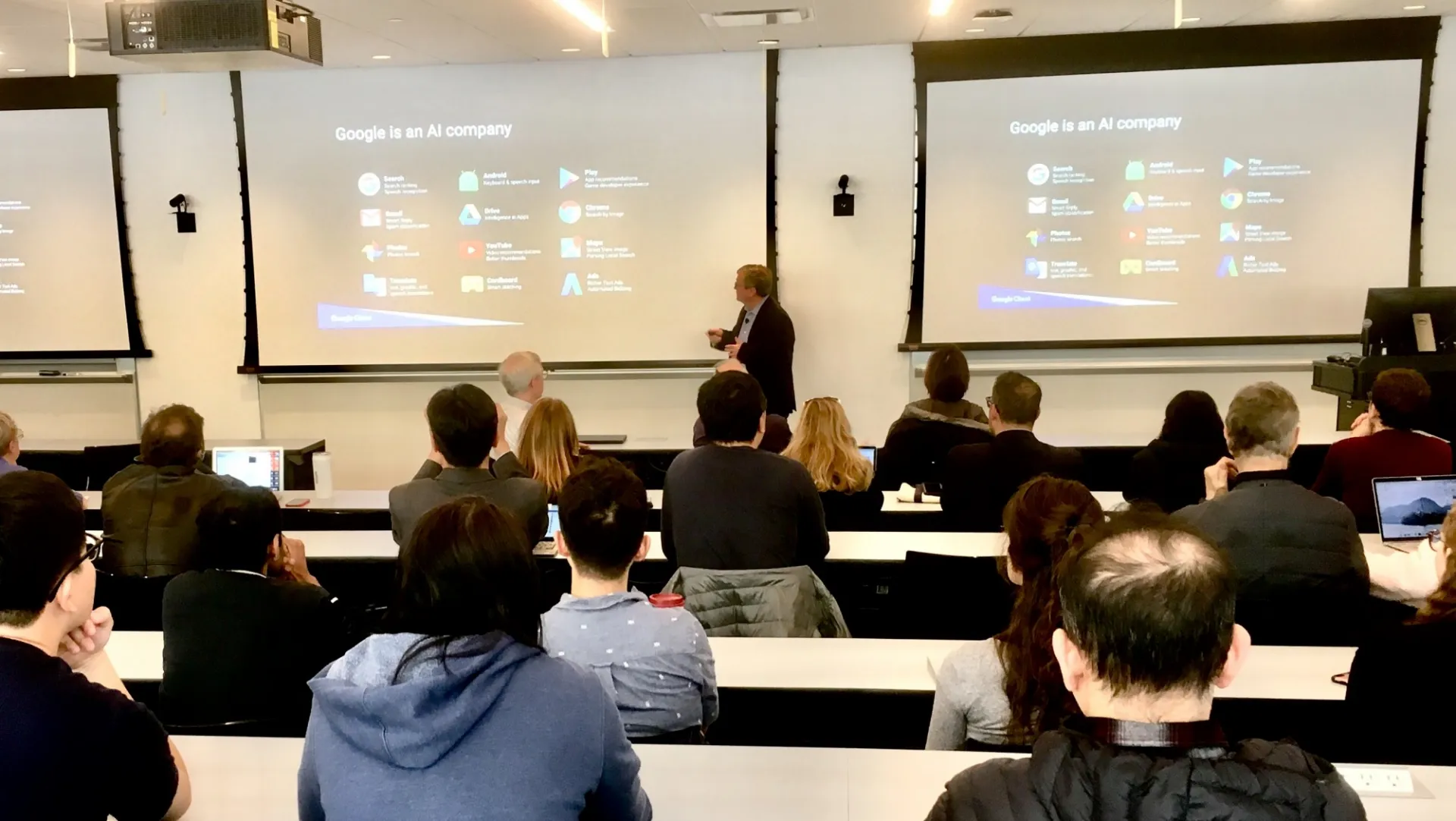
Beyond the visible products and services Google provides, Mr. Ramsey explained that Google is also a major hub of research. Over 90% of research done at Google is encapsulated within fields such as artificial intelligence, machine learning, natural language processing, and human-machine interactions. Furthermore, in their mission in advancing human knowledge, helping learning, and improve lives, Google has open sourced a lot of the projects created during such research.
The ultimate aim of Google’s AI/ML research, Mr. Ramsey expressed, is to create an artificial general intelligence (AGI): an artificial intelligence indistinguishable from a real human. Stepping stones Google has developed in this mission include the AlphaGo, AlphaZero, and AlphaStar projects, which are respectively AI’s trained to play Go, chess, and Starcraft. Each project requires different levels of premeditated strategy, and each project has succeeded in winning against the best human players in each respective field.
A key part of Google’s mission also includes democratizing artificial intelligence by making it accessible, fast, and useful for enterprises and developers, in particular through the usage of Google Cloud. Mr. Ramsey explained in his talk that one of the key components holding the development of artificial intelligence and machine learning back was the hardware capabilities that AI/ML software was run on.
Previously, large amounts of data were processed by GPUs (graphics processing units), but their expense and size limited the amount of work each unit could produce. However, an alternate option arose through the development of 3D gaming software-TPUs (tensor processing units), which handled matrix transforms (a key component of machine learning implementation) at much greater efficiency. Google developed TPUs to handle specifically AI and ML oriented processes, resulting in a product that was both cheaper and more efficient than the standard GPU. By using the newly developed TPU, Google has been able to create supercomputers of enormous scale, which they have made available to both Google’s research community and everyday users through their Google Cloud services.
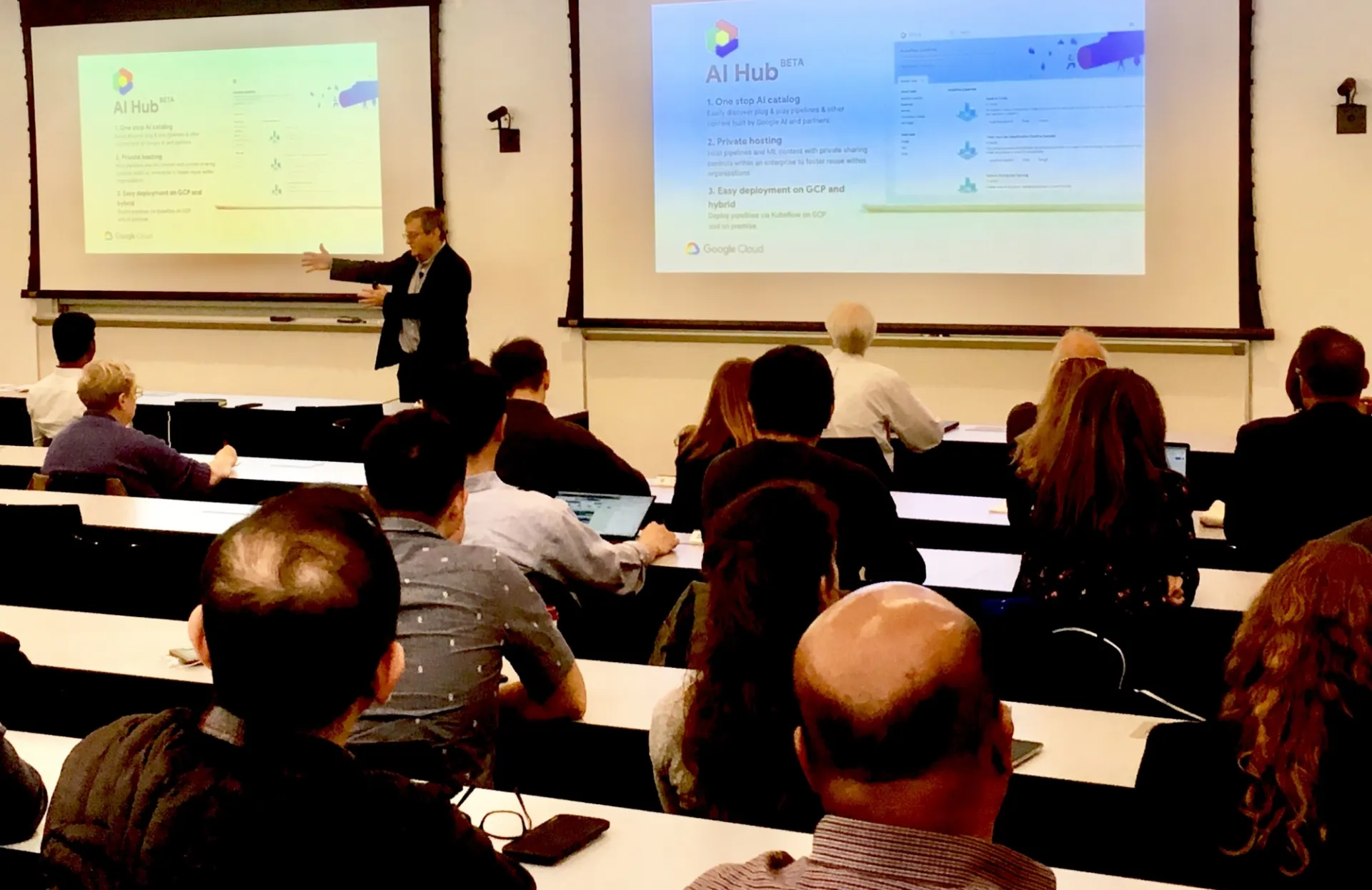
Some of the services Google Cloud offers include AI Platform, AI Hub, Notebooks, BQML, AutoML, and many more. The range of these services offer AI and ML capabilities to people with a range of expertise, from ML experts to data scientists unfamiliar with the intricacies of ML implementation. For more details, visit their website.