The Future of Technology in Art and Healthcare: James Pearce and Olivia Davis
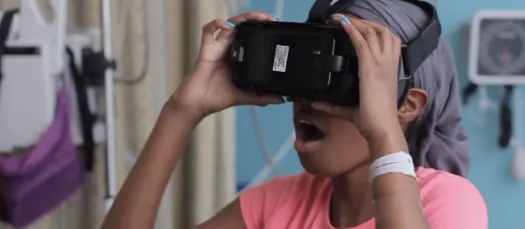
For our November event, ETC was very excited to host Olivia Davis, Curator for The Fine Art Program and Collection at Montefiore Einstein, and James Pearce, Emerging Technologies Manager at the Fashion Institute of Technology. They shared their journey in creating the CHILZone: The Children's Hospital Innovation Lab @ Montefiore, as well as addressing the overall work in merging new technologies, medicine, and the arts.
James Pearce first introduced his role at the Fashion Institute of Technology (FIT), which includes running the Faculty Research Space, a cross-disciplinary studio where faculty and students can work alone, together, across schools and departments, on emerging technology exposure, experimentation, and research with an emphasis on practical application: to use tech as a catalyst to help create things of value that are personalized, sustainable, ethical, and globally relevant. In particular, Mr. Pearce emphasized how he introduces and demystifies emerging technologies to specialists within the arts in order to better aid their artistic vision, as well as democratizing new technologies in both their use and accessibility.
Examples of this fusion includes workshops on teaching poetry faculty how to utilize 3D printing and extended reality technologies to better enhance their teaching, as well as the production of artistic works. Another project the department is working on advancing technology of a virtual wardrobe, where users can input their dimensions and see how certain clothes will fit their body types, with both static and moving models. This technology is designed to help reduce waste of e-commerce transportation, when users buy clothes to try, and return unsuitable items. FIT students and graduates also are also making strides within the industry with emerging technologies: a current student-led project aims to reinvent the ballet pointe shoe using a 3D printed insert tailored to each dancer’s foot in order to increase the longevity and performance of the pointe shoe. The department also participates in collaborative projects such as their work at Montefiore’s CHILZone.
The history and details of the CHILZone were introduced by founder, director, and curator Olivia Davis. Ms. Davis is in charge of purchasing and commissioning pieces of art for Montefiore, and designed the CHILZone to help pediatric patients manage pain through dynamic art that uses VR, AR and 3D printing. Static art and generic imagery, Davis explained, is often not as effective connecting with patients compared to dynamic and tailored art experiences. Many children in the Montefiore system, for example, are from South Bronx and may have difficulty connecting to images unrelated to their home and personal experiences, such as "traditionally" soothing images like campfires or West Coast beaches. Therefore, Davis focused on bringing immersive experiences using interactive virtual reality, augmented reality, and 3D printing, tailored to each kid’s personal experience to allow them to heal faster and more effectively.
Davis commissioned Tom Christopher, a traditionally-trained artist, to create a virtual reality immersive landscape of New York City. To adapt Christopher’s experience in traditional mediums to a technological arena, Davis worked with James Pearce and FIT to equip Christopher with the training to use Google’s Tilt Brush, allowing Christopher to use apply his personal style in a digital medium. Using observations and data collected from watching the bustle of New York City life, Christopher was able to create an immersive experience that was simultaneously comforting and fantastical for the patients:
The extended reality experience also includes many other facets, such as having multiple people being able to be in the same experience at once, allowing kids to interact in the space with friends outside of the hospital. The program is also working to 3D print objects from the virtual world, giving patients the immersive experience both with and without an XR headset. Going forward, the CHILZone is partnering with the Bronx Zoo to create augmented reality overlays of animals roaming the hospital and interacting with the children.
In terms of efficacy, Davis presented several concrete studies showing the link between extended reality pain management allowing a decrease in opioid dosage in both adult and pediatric patients. Current studies are also underway to explore more into the science behind treatments with AR/VR.