Emerging Technologies at Integrity Week 2026
Integrity Week 2026 Explores Responsible AI and Academic Integrity
Integrity Week at Columbia brings the campus community together for candid conversations about ethics and integrity in research, teaching, and learning—grounded in honesty, trust, fairness, respect, and responsibility. This year’s theme focused on the impact of generative artificial intelligence on academia, and one session approached that challenge through a practical question: as AI becomes easier to use everywhere, how do we center academic integrity?
As part of the week’s programming, Victoria Malaney-Brown invited Emerging Technologies. On February 12th, Spencer Ames (Associate AI Analyst) led a workshop-style presentation, “Responsible AI: Safe and Ethical Use”.
The headline: AI adoption is moving faster than responsible use
The session opened with a framing that resonated throughout the discussion: AI capabilities and adoption have rapidly outpaced our thinking about responsible use (Stanford 2025).
This gap shows up in classrooms, labs, and administrative workflows alike, often not because people are acting in bad faith, but because powerful tools create new habits faster than institutions can build shared norms.
That mismatch is especially consequential in a university setting, where integrity, credibility, and trust are essential for scholarship and learning.
A practical definition of AI
Rather than treating AI as magic or as inherently harmful, we use a grounded definition: AI is a technological system that processes data into predictions, recommendations, decisions, and/or content, within a socio-material context, and with some degree of autonomy from human actors (Blair Attard-Frost 2025).
This definition seeks to reframe the discussion: the biggest risks are rarely the technology alone, but the incentives, workflows, and accountability structures around it.
Why responsible AI matters at Columbia
The presentation outlined three drivers for why responsible use is now a campus-wide issue:
- AI is no longer a single tool—it’s a capability embedded across many tools and workflows, affecting writing, analysis, coding, decisions, and communications.
- AI introduces new failure modes, including being confident and wrong (hallucinations), amplifying biased patterns in data, and scaling both benefits and harms at speed.
- Trust and legitimacy matter in a university setting, where teaching quality, research integrity, public trust, and critical thinking are central outcomes.
Six principles for responsible AI use
At the center of the talk was a working definition: Responsible AI means critically choosing, designing, and using AI in ways aligned with human values and academic goals, attentive to risks and impacts, and supported by clear human accountability.
From there, the session organized responsible practice into six principles (adapted from Microsoft 2024):
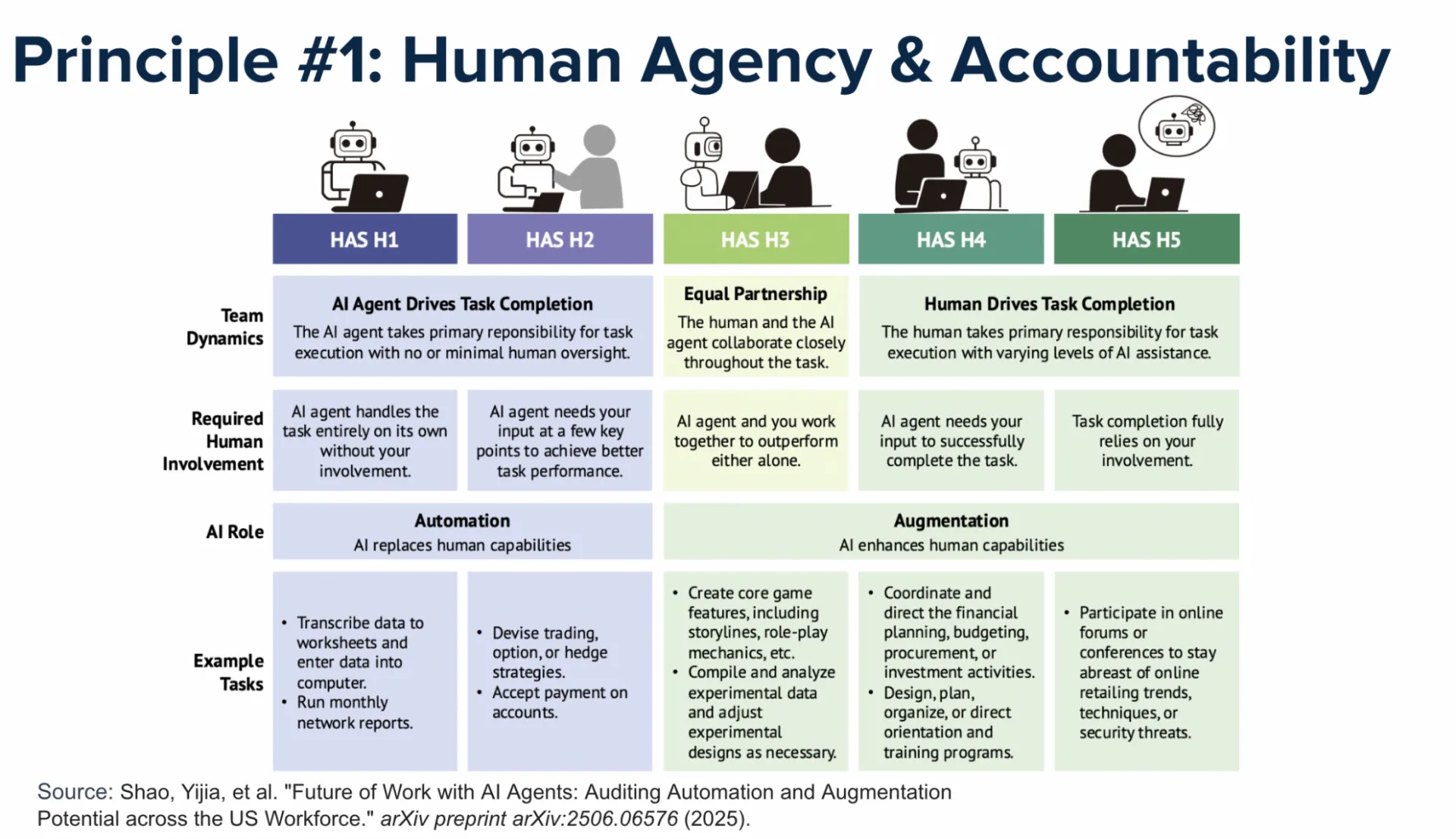
- Human agency and accountability: People remain responsible for outcomes. Responsibility doesn’t transfer just because a tool was provided by a vendor or institution. This is perhaps the most frequently important principle for students: if used, AI should support critical thinking rather than replacing it.
- Fairness and inclusion: AI can treat groups differently due to uneven data, assumptions, or context, and small biases can compound across a diverse community.
- Privacy and data respect: The discussion emphasized minimizing exposure, especially around copyright, as well as student, personnel, research, and health-related data.
- Transparency and explainability: Trust depends on clarity about when AI is used and how it shapes outcomes. We should seek to foster a culture of transparency about this.
- Safety, security, and reliability: Plausible-sounding outputs can still be wrong; reliability is not the same as accuracy.
- Ongoing monitoring: Responsible AI is not a one-time checklist—capabilities change, contexts shift, and behavior can drift.
From principles to practice: lifecycle thinking and evaluation habits
The presentation also encouraged participants to zoom out from individual prompts and consider the AI lifecycle, emphasizing that universities often operate in the post-deployment phase as system operators and end users, where responsibility includes how tools are distributed, used, and monitored in real conditions.
To make that concrete, the session offered a simple evaluation mindset: treat every output as a draft, verify facts, and check for bias, privacy, and policy compliance.
The workshop also introduced the ETHICAL Framework for AI-Enhanced Research (Eacersall et al. 2024), which encourages users to examine policies, think about social impacts, understand the technology, indicate AI use, critically engage with outputs, access secure versions, and review user agreements.
Scenario-based discussion
To connect the principles to real academic contexts, participants discussed two scenarios:
Scenario 1: A student asks a chatbot for research papers, receives hallucinated citations, and doesn’t check.
Participants pointed to multiple layers of breakdown: citing work not read, relying on fabricated sources, and the reality that faculty may not have time to verify every citation, meaning the habit can persist unnoticed.
The conversation also surfaced how integrity failures can be incentive-driven (time pressure), and how culture matters, such as creating environments where students feel they can ask for an extension rather than outsourcing their thinking in panic.
Scenario 2: A research assistant uploads sensitive patient information to a personal account.
Here, the discussion moved quickly into risk management and data governance. We established that data cannot be retracted after upload, and one participant summarized a key mitigation tactic succinctly: use the Columbia account (secure version) rather than a personal account. Furthermore, we emphasized the importance of understanding data classification boundaries.
What the community asked for next
The Q&A focused on the desire for more usable guidance in day-to-day teaching and learning.
- More actionable course policy support: Participants noted that high-level guidance can sometimes feel insufficient, and asked how instructors can build ethical AI use into syllabi (including ideas like requiring students to share prompts) as well as how we can establish discipline-specific norms. Spencer pointed toward resources and ongoing efforts from Emerging Technologies and the Center for Teaching and Learning.
- Second- and third-order consequences: A student raised a broader integrity concern: once AI-generated or hallucinated content enters public-facing work, it can become part of a citation cycle—where others treat it as credible because it appears under a Columbia name.
Takeaway: responsible AI is a practice, not a stance
The Integrity Week session ultimately framed responsible AI as neither anti-AI nor hype-driven adoption.
Instead, it’s a set of shared habits: keep human accountability anchored, be explicit about augmentation vs. automation, protect sensitive data, disclose and cite AI use when appropriate, and treat outputs as drafts that demand verification.
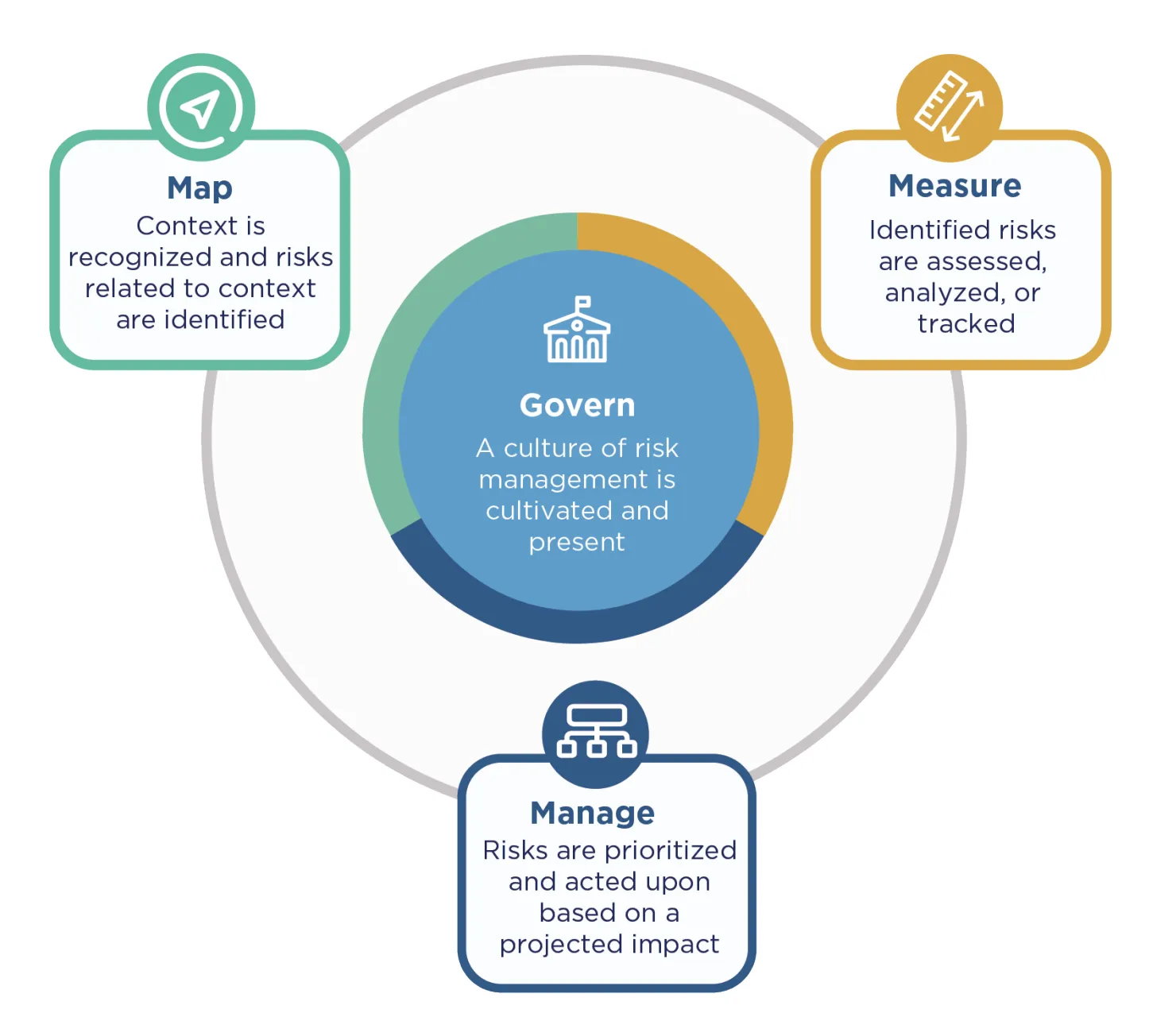
AI systems will keep changing, so our definitions, policies, and norms must evolve too, through continuous mapping, measuring, and managing risk.
For questions or collaboration: [email protected]
Useful links
Slide deck: tinyurl.com/CUresponsibleAI (only accessible to Lionmail users; please do not distribute)
Provost's AI Policy: available here
Works Cited
Attard-Frost. (2025). “Ethics & Governance of AI Seminar”
Eacersall et al. (2024). “Navigating Ethical Challenges in Generative AI-Enhanced Research".
Microsoft. (2024). “Responsible AI Principles and Approach”.
NIST. (2023). Artificial Intelligence Risk Management Framework.